

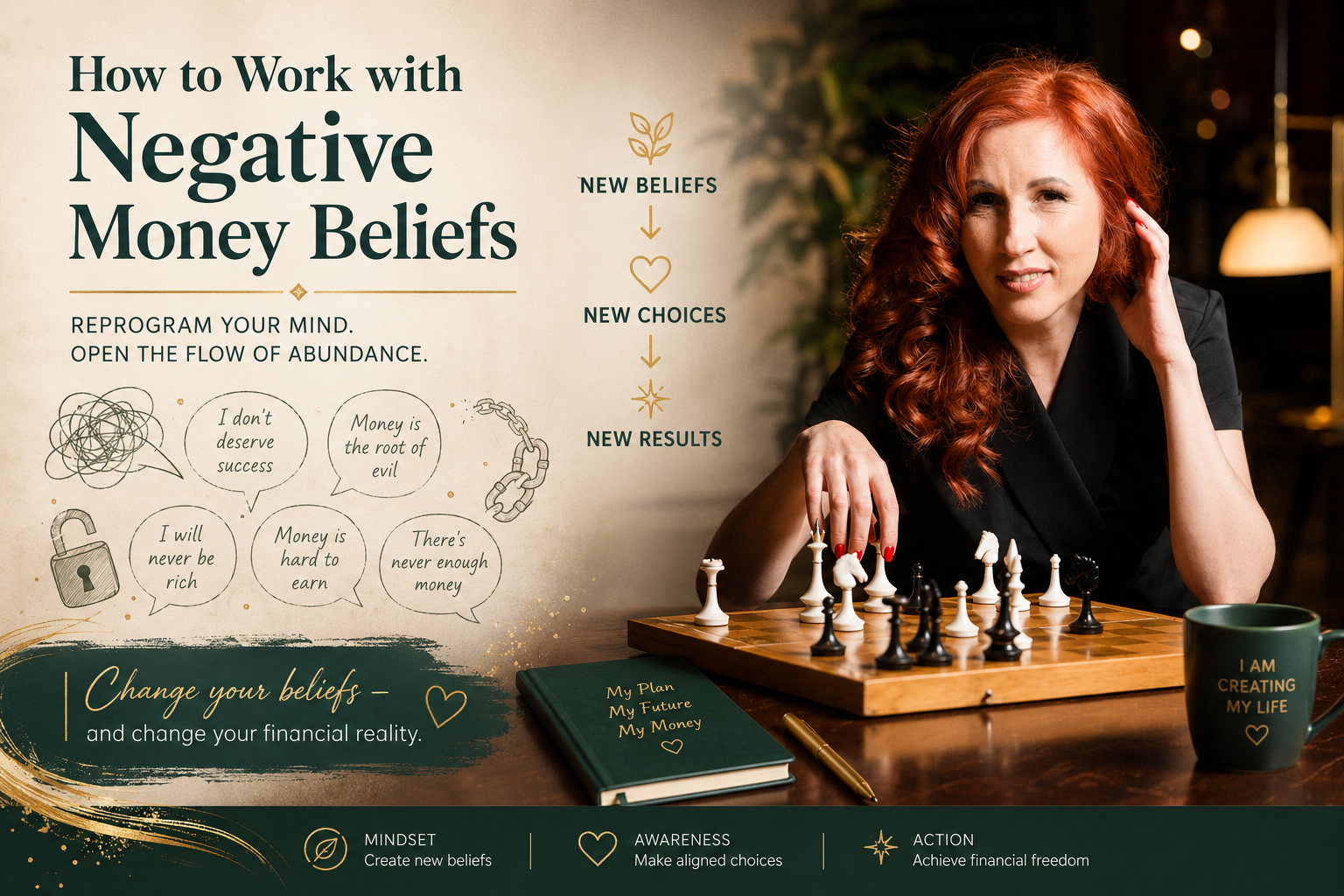
How to Work With Negative Money Beliefs
In this material, I want to talk about negative and positive beliefs about money, working with your internal programming, and expanding your financial capacity.
Negative beliefs about money can create a strong psychological barrier that limits financial well-being and income. These beliefs form consciously or unconsciously and influence perception, attitude toward money, and financial behavior.
Every person has the ability to change their mindset, thoughts, and views about finances. By doing so, they can improve their financial situation, increase income, discover new sources of profit, and allow the energy of money to flow more easily and naturally into their life.
Do you know how this works? Let me briefly explain. If a person believes that money is something bad or feels they do not deserve success, they unconsciously create situations that confirm these beliefs. This often shows up through accepting low payment, being unable to raise prices, or even becoming a victim of manipulation or financial loss. In other words, a person subconsciously rejects opportunities for financial growth or constantly creates circumstances where money becomes a problem.
My deep work as a coach is focused on helping clients identify and rethink their negative beliefs and attitudes about money. This is achieved through uncovering the root causes of these beliefs, understanding how they affect financial behavior, and replacing them with constructive beliefs that support financial success.
One of the approaches I use is exploring the origin of negative money beliefs. These beliefs may come from childhood, family history, painful personal experiences, society, or even religion. By examining the root of the problem, we begin to understand how these interpretations shape financial reality. After that, we work on replacing these beliefs with new supportive thoughts and statements. This may include positive thinking practices, affirmations, visualization, and deeper subconscious work.
For example, instead of the belief “money is bad,” we can shift toward “money creates opportunities for growth and fulfillment.” This helps reprogram mental patterns and build a foundation for attracting positive financial outcomes.
In the final stage, I provide clients with practical tools and strategies for financial literacy and money management. This may include budgeting skills, financial planning, investment strategies, and understanding financial risks and opportunities. Together, we create an individual action plan that aligns with the client’s financial goals and needs.
100 Negative Beliefs About Money
Below you will find a list of common beliefs and attitudes about money. These examples were collected from open sources, my own experience, and the experiences of my clients.
You can copy this list, print it out, and begin working with it right away. Read through each statement carefully and choose the ones that resonate most strongly with you. If you cannot print the list, simply write the statements down in a notebook.
- If I become rich, people will envy me
- Big money can only be earned dishonestly
- Money cannot buy happiness
- You have to fight for every penny
- Chasing money destroys health and relationships
- You must choose between money and love
- Money always disappears quickly
- Wealth takes away true values
- Wealth depends on luck, not effort
- Big business destroys the planet and the environment
- Rich people are robbed and attacked more often
- It feels shameful to talk about wealth when others cannot afford food
- All rich people are greedy and arrogant
- I cannot ask for more money because it would be unfair to my colleagues
- I never have enough money
- To earn well, you must work extremely hard
- Money does not come easily
- Men have it easier when it comes to earning money
- I regret spending money on myself
- I do not believe I will ever have a lot of money
- I cannot earn more because it would require sacrifices I do not want to make
- More money means more problems
- Rich people are unpleasant
- To become wealthy, you have to be born into a different family or country
- Rich people are lonely
- Wealthy people do not care about the poor
- I spend all my money quickly
- I am constantly in debt
- Money makes me feel guilty around people who have less
- If life becomes too good, the Universe will “balance it out” by taking something away
- I need to stay in lack in order to grow
- I enjoy spending more than earning
- If I become rich, I will have to change myself and lose authenticity
- When I receive money, it means someone else loses it
- I am bad with finances
- I have problems earning money
- Money is not important, the soul is what matters
- Every time I save money, something happens and I have to spend it
- I have a poor person’s mindset
- You must always save for a “rainy day”
- Money is not distributed fairly
- Not everyone deserves money
- The more money you have, the less time you have
- The harder you work, the more you earn
- I judge people’s success by how much money they have
- Nothing good comes for free
- I do not know how to increase my income
- Money can disappear at any moment
- Money ruins people
- It is unfair that some people are rich and others are poor
- I do not want to stand out because of my wealth
- My success causes aggression or jealousy in people close to me
- I am not good enough to have millions
- I will never have tens of millions
- I cannot imagine a life where I do not constantly think about money
- I do not understand investing
- To receive something, you must first sacrifice something
- People will judge me if I become wealthy
- A meaningful career cannot bring good money
- It is too late for me to become financially successful
- Loving money feels wrong
- I feel uncomfortable around people who constantly talk about money
- In my family, money was always the cause of conflict
- You should give more and receive less
- True freedom means being independent from money
- Financial stability makes people lazy
- Someone else needs this money more than I do
- In my country, having large amounts of money is dangerous
- Spending money makes me afraid it will run out
- I cannot have more than fate has assigned to me
- A person cannot be both kind and rich
- My work will never bring enough money
- To earn a lot, you must own a business
- Money is just money and not important
- The rich get richer and the poor get poorer
- I come from a poor family
- I cannot manage money properly
- Wealthy people manipulate others
- If I become wealthy, men will fear me
- Someone else should help me manage my money
- Only frugal people have money
- I cannot influence how much money I will earn in the future
- My current financial situation is the result of circumstances beyond my control
- There is nothing worse than having no money
- Poverty creates sympathy, wealth creates judgment
- Rich people cannot understand poor people
- Money gives freedom
- Wealthy people forget where they came from
- Nothing should be done purely for money
- In my profession, it is impossible to earn a lot
- The main goal is to marry successfully
- Not all money is “good money”
- Debt is bad
- Money has never come easily to me
- Spending money on myself is selfish
- If I make money from my knowledge, I am using people
- Money loves silence
- If I earn a lot, people around me will start using me
- I am too old to become rich
Exercises for Working With Negative Money Beliefs
In my work, I prefer clear and practical tasks that help clients achieve real results. When it comes to financial mindset, we always choose a specific financial goal the client wants to reach in the most effective way possible.
Remember: money is connected to your reality. No coach can help if you refuse to take action. My role is to help change destructive thoughts that lead to destructive actions. Once the brain receives a new program, the client decides whether to follow the new beliefs or continue living according to old patterns.
Below, you will find a step-by-step process. I truly hope these exercises inspire you to take action. I believe every person, regardless of age or circumstances, can improve their financial situation.
So let us begin. Take a notebook and a pen, and start training your mind to choose a different version of reality.

Preparation for the Practice
Financial Goal
Any financial work should begin with a clear goal. Give yourself a few minutes, enter a calm and meditative state, and allow yourself to see the amount your soul is truly ready for.
Write down the answers to these questions:
- What amount of money do you want to reach? This should not be an abstract million-dollar dream. Choose an amount your body emotionally responds to.
- Why do you want to work through your negative money beliefs?
- How do you want your life to change as a result of these practices?
- Who or what can support you through these changes?
- What personal qualities, strengths, or talents can you rely on to transform your relationship with money?
Practice 1
Choose between one and three beliefs per day. Avoid taking more than that so your nervous system has time to adapt to new neural patterns, energies, and behaviors.
- Choose and write down one negative belief
- Rate its influence on your life from 1 to 10
- Remember all situations connected to this belief
- Ask yourself honestly:
“What emotions do I feel when I read this statement?”
Write down the emotions specifically - Ask yourself:
“When I feel these emotions, what actions do I take?” - Rewrite the negative belief into a positive one
- Read the new statement and notice your emotional state
- Ask yourself:
“How do I want to behave when I feel this way?” - Final question:
“What results and changes will these new actions create in my life?”
Practice 2
Approximately 80% of money beliefs are formed not through reality itself, but through influential people in our environment.
For example, one of my clients grew up hearing her father complain daily that life was unfair and that only dishonest people became rich. As a child, she accepted this as truth. Later, as an adult, she saw her friend build a successful and ethical business. This created an internal conflict between two realities: her father’s worldview and the evidence she saw in real life.
During deep coaching work, we discovered she constantly searched for proof that her friend’s success must be dishonest. Admitting otherwise would mean accepting that her father’s beliefs were wrong, which emotionally felt like betrayal.
This practice helps separate love and respect for family members from unhealthy beliefs inherited from them.
Take two sheets of paper.
Sheet 1
- Choose one negative money belief
- Remember the person from whom you heard it most often
- Write the following text:
“(Name), I recognize that your belief about money became deeply rooted in my life. I respect the path you lived and the experiences you had.
By my own choice, I accepted this belief and built many financial decisions around it. Thank you for the role it played in my life, but this belief no longer works for me.
From this moment forward, I choose to think, act, and live differently.
I return this belief to you. I have the right to choose my own thoughts, financial strategies, and relationship with money.
Perhaps this belief once helped you survive or feel safe. But my soul, body, and identity choose another path — one filled with freedom, abundance, and financial growth.
I release this belief and create space for new thoughts and possibilities around money. I allow myself to build a peaceful and healthy relationship with financial energy.”
After writing the letter, imagine this person standing in front of you. In a meditative state, mentally hand them the letter and feel yourself releasing the belief.
You may burn or throw away the paper afterward.
Sheet 2
Write your new beliefs about money in any form you wish.
Describe:
- how you want to think about money
- how you want to behave financially
- what you want to say about wealth
- how you want to react to income and expenses
Fill the emotional space left after releasing old beliefs with new emotions, dreams, ideas, and possibilities.
Practice 3
Practices 3 and 4 are designed for professionals such as coaches, psychologists, and financial consultants.
Ask the client to create a list of positive aspects of money:
- opportunities money creates
- ways it improves life
- ability to support family
- freedom and independence
- helping others
- achieving goals and dreams
Then ask the client to emotionally connect with each point and imagine themselves living that reality.
Create an “anchor” that helps the client shift into a positive emotional state around money. This may be:
- a gesture
- a word
- a phrase
- a physical movement
Practice using this anchor while discussing old negative beliefs.
Practice 4
- Ask the client to choose one negative money belief
- Discuss how it limits their life
- Help them find evidence against this belief
- Create a new empowering belief
Example:
“Money always comes through struggle” becomes
“Money comes to me naturally and consistently” - Ask the client to imagine their life with this new belief
- Have them answer the question five times:
“Why is this true for me?” - Finish the session with clear, measurable actions and deadlines
Example:- send resumes to five companies before June 6
- prepare a business plan before October 11
- Create a plan for emotional support during setbacks or moments of doubt
Final Integration
Complete these actions after each practice:
- Write down the actions you now feel inspired to take
- Make these actions specific and include deadlines
- Create a list of people who can support you emotionally or practically
- Decide how you will celebrate your progress and achievements
Your brain must learn to associate financial growth with pleasure, confidence, and safety.
These coaching exercises and techniques allow clients to work with negative money beliefs on a deep subconscious level, reprogram old mental patterns, and create new beliefs that support financial success and prosperity.
It is important to understand that changing beliefs is a process. It requires self-reflection, openness, patience, and consistent action. A coach can guide and support you through this process by helping uncover hidden blocks and introducing new ways of thinking and acting.
Over years of coaching sessions, I have developed a deep understanding of how beliefs influence financial behavior and personal growth. My clients gain clarity, inspiration, structure, and stronger financial awareness. Through my individual approach and practical tools, I help people transform their relationship with money, unlock new opportunities, and create greater stability and success.
I invite you to a consultation where we can work together on your negative money beliefs and create a clear action plan for achieving your financial goals.
May this process become the beginning of new opportunities, a new relationship with money, and a new level of financial freedom in your life.